


Dashboard warning lights are read by colour: red means a serious fault or danger and you should stop safely as soon as possible, orange (yellow) warns of a fault that needs a workshop, and green, blue or white only tell you that a function is switched on. A second rule: a flashing light usually means a more urgent problem than a steady one. The exact meaning of a symbol in a given car is always in its owner's manual.
If a light comes on in a car from our car rental in Bratislava, you do not have to diagnose anything yourself: with a red or flashing light, stop and call our 24/7 assistance. Below are tables of the most common symbols, the headlight indicators and the lights that also count as a defect at the Slovak roadworthiness test (STK).
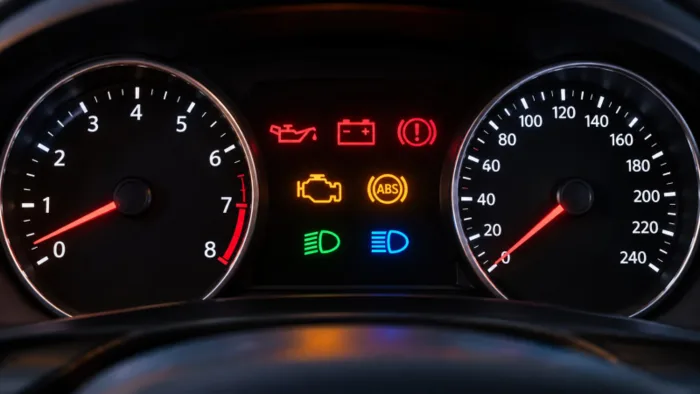
What do the colours of dashboard warning lights mean?
| Colour | Meaning | What to do |
|---|---|---|
| Red | serious fault or safety risk | stop safely as soon as possible; for oil and temperature switch the engine off |
| Orange / yellow | fault or system warning | continue carefully and visit a workshop soon |
| Green, blue, white | a function is on (lights, cruise control, assistants) | nothing, information only |
When you switch on the ignition, most lights come on for a few seconds while the car tests its systems. A problem is a light that stays on after the engine starts or comes on while driving.
Red warning lights: when to stop immediately
A red light while driving means that carrying on can damage the engine or put you at risk. For oil, temperature and brakes, stop as soon as it is safe.
| Light | What it looks like | Meaning | What to do |
|---|---|---|---|
| Oil pressure | oil can with a drop | low oil or lubrication fault | stop at once, switch the engine off, do not drive on |
| Coolant temperature | thermometer in waves | engine overheating or coolant leak | stop, switch off, do not open the hot reservoir |
| Charging | battery with + and − | alternator is not charging | switch off unneeded consumers and get to a workshop; the engine may stall |
| Brakes | (!) in a circle or the letter P | handbrake on, low brake fluid or brake fault | release the brake; if it stays on, stop and do not drive |
| Airbag | seated figure with a circle in front | airbag fault or passenger airbag switched off | workshop; the airbag may not deploy in a crash |
| Seat belt, doors | figure with belt, car with open doors | someone is unbelted, a door, boot or bonnet is open | buckle up, close it |
Orange and yellow lights: when to visit a workshop
An orange light usually does not mean you have to stop at once. The car is reporting a fault that a workshop should check soon. The exception is a flashing engine light.
| Light | What it looks like | Meaning | What to do |
|---|---|---|---|
| Engine (check engine) | engine outline | engine management or emissions fault, power may be reduced | steady: workshop within days; flashing: slow down and stop as soon as possible |
| EPC | letters EPC (Škoda, VW, Seat, Audi) | engine electronics or throttle fault | workshop; power may be limited |
| ABS | ABS in a circle | anti-lock system is off, normal brakes still work | brake more gently, workshop |
| ESP / ESC | car with wavy tracks | flashing: system is intervening; steady: switched off or faulty | slow down when flashing; if steady, workshop |
| Tyre pressure | tyre cross-section with an exclamation mark | pressure drop in a wheel | check for a puncture and inflate |
| Diesel particulate filter (DPF) | rectangle with dots | filter is full and needs regeneration | drive at higher speed, according to Hyundai above 2,500 rpm, until it goes out |
| Glow plugs (diesel) | coil | after ignition on: pre-heating; while driving: fault | start the engine only once it goes out |
| AdBlue | AdBlue text or a drop | AdBlue is running low | top up; once empty, the engine may not restart |
| Service | spanner | service is due | book a service |
| Fuel | fuel pump | tank on reserve | refuel |
| Frost | snowflake | outside temperature low enough for icy roads | expect black ice |
Headlight indicators: position, dipped, main beam and fog lights
The colours of headlight indicators are harmonised by UNECE Regulation No. 121, so they look the same in a Škoda and in a Mercedes.
| Lights | Indicator colour | What it looks like |
|---|---|---|
| Position (parking) lights | green | two small half-round lamps facing away from each other |
| Dipped beam | green | headlamp with beams angled downwards |
| Main beam | blue | headlamp with horizontal beams |
| Front fog lights | green | headlamp with angled beams crossed by a wavy line |
| Rear fog light | yellow / amber | lamp facing right with horizontal beams and a wavy line |
| Turn signals | green | two arrows, flashing |
In Slovakia, dipped headlights or daytime running lights must be on whenever you drive, all year. In reduced visibility daytime running lights are not enough; details are in winter tyres and mandatory car equipment in Slovakia.
Flashing or steady? The difference that matters
- Engine light flashing: usually an engine misfire. Unburnt fuel can damage the catalytic converter. Slow down and stop as soon as possible.
- ESP flashing: the system is preventing a skid. That is fine, you are just at the limit of grip, especially in winter.
- Glow plug light flashing while driving: an engine management fault, not pre-heating.
- Turn signal flashing faster than usual: usually a blown indicator bulb.
Which warning lights are also a problem at the STK?
Under Annex I of Directive 2014/45/EU on periodic roadworthiness tests, which Slovakia applies at the STK, the inspector records a defect when a warning light shows a fault in:
- brake fluid level,
- ABS,
- electronic stability control (ESC),
- electric power steering (EPS),
- airbags and restraint systems (SRS).
Non-working headlight indicators are also a defect, especially for main beam and the rear fog light. What happens if a car misses its STK is covered in our article on the STK fine in Slovakia.
What should you do when a light comes on in a rental car?
- Note the colour and whether it flashes. With a red or flashing light, stop safely.
- Take a photo of the dashboard with the light and the mileage. It makes things easier with the rental company.
- Call the rental company's assistance. With a red oil, temperature or brake light, do not drive on.
- With an orange light, agree whether you can continue to your destination or whether the car will be replaced.
Always carry the car's documents as well, see documents to carry in a car in Slovakia.
FAQ
Can I drive with the orange engine light on?
If it is steady and the car drives normally, you can continue carefully, but have it diagnosed soon. If it flashes, slow down and stop as soon as possible to avoid damaging the catalytic converter.
What does a red exclamation mark in a circle mean?
It is the brake warning light. Most often it means the handbrake is on. If it stays on after releasing it, brake fluid may be low or the brakes faulty; do not drive.
What does the position light indicator look like?
A green light with two small half-round lamps facing away from each other. Dipped beam shows a green headlamp with beams pointing down, main beam a blue headlamp with horizontal beams.
Why is the snowflake light on?
It warns that the outside temperature is low enough for the road to freeze. It is not a fault.
Why do all the lights come on when I start the car?
The car tests its systems at start-up. The lights should go out after a few seconds. If one stays on, that system is reporting a fault.
Updated 19 November 2026. Sources: Hyundai Slovakia, What the warning lights in a car mean; UNECE Regulation No. 121 (tell-tale symbols and colours); Directive 2014/45/EU, Annex I (EUR-Lex); Slovak Act No. 8/2009, § 32. The exact meaning of a symbol in your car is in its owner's manual.